Expert Insights from LOVOL — Powering the Future of Sustainable Agriculture
Introduction
Why Electric and Hybrid Tractors Are Reshaping Modern Agriculture in 2026
The agricultural industry is undergoing its most profound transformation in decades. After years of concept validation and prototype demonstrations, 2026 marks the critical turning point where electric and hybrid tractors are moving from pilot projects to large-scale adoption on farms around the world.
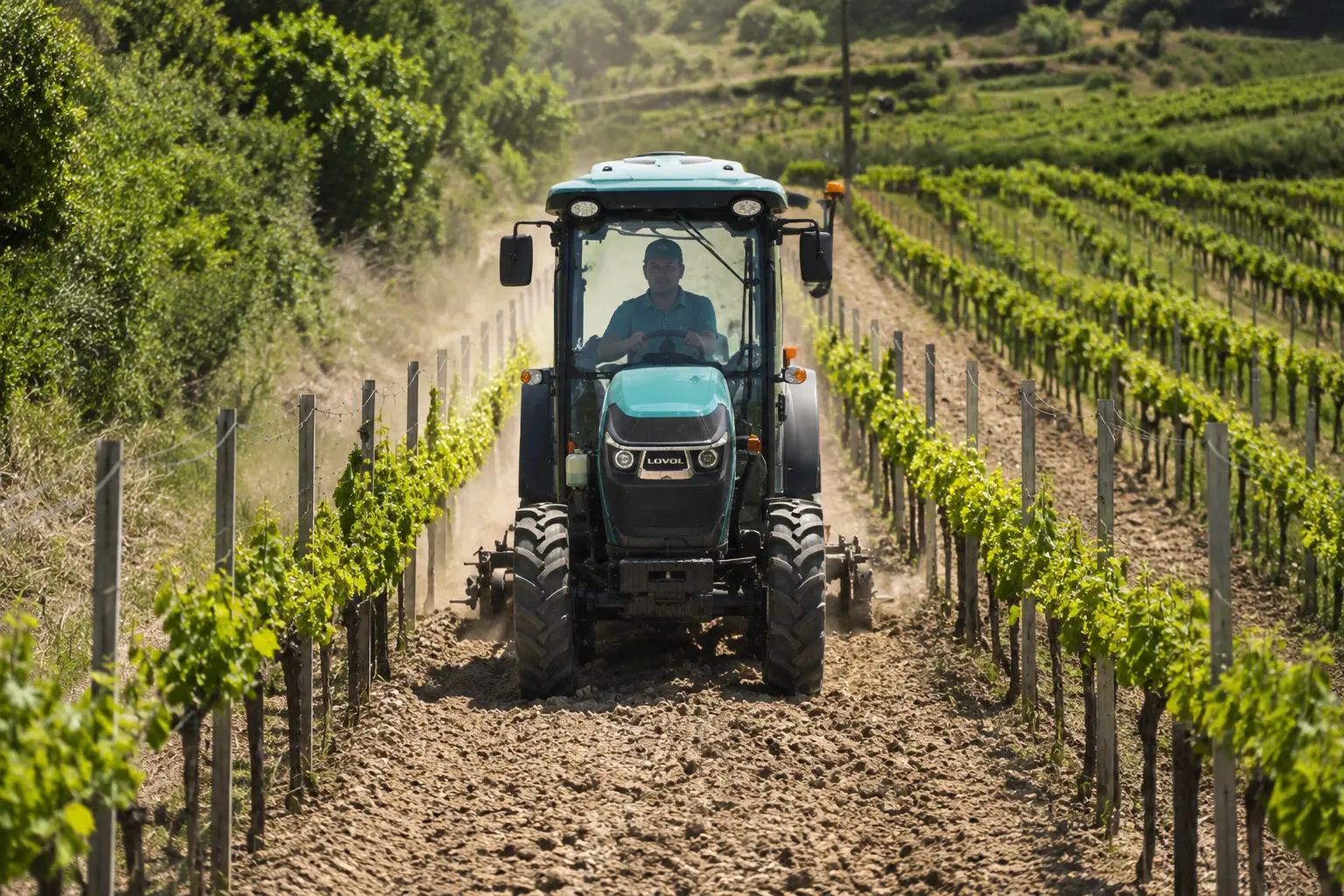
Market data confirms this trend is accelerating. According to Fortune Business Insights, the global electric tractor market is projected to grow from $0.48 billion in 2026 to $1.69 billion by 2034, representing a electric tractor market growth CAGR of 17.04%. Declining battery costs, improving charging infrastructure, and farmers’growing recognition of total lifecycle cost advantages are key drivers behind this rapid expansion.
Policy momentum is equally strong. The U.S. EPA’s Tier 4 emission standards for nonroad diesel engines, first introduced in 2004, have set stringent limits on NOx and PM emissions. The European Green Deal's "Farm to Fork" strategy is working to build a fair, healthy, and environmentally-friendly food system. Meanwhile, China’s dual-carbon goals are accelerating the country’s green transition through the 15th Five-Year Plan carbon peaking action plan, pushing industries including agriculture to reduce emissions. Together, these policies are creating a market environment that increasingly favors new energy farm equipment—and they are already influencing purchasing decisions today.
Expert Insights from LOVOL
As a total solutions provider for agricultural equipment, we have long been preparing for this transition. Our complete portfolio of electric and hybrid tractors now covers all major farming scenarios—from orchards and livestock farms to large-scale field operations and small-to-medium-sized European farms. With zero tailpipe emissions, significantly reduced noise levels, and intelligent control systems, our zero emission tractor lineup is proving that sustainable farming can be smarter and more cost-effective at the same time.
Understanding the technology behind these machines is the first step toward making an informed purchasing decision.
Understanding the technology behind these machines is the first step toward making an informed purchasing decision.
Technology Deep Dive
Electric Tractor Technology Explained (2026): From Battery to Drivetrain
Understanding what powers an electric tractor requires looking at 4 interconnected systems: the battery, the powertrain, the charging solution, and the control architecture. Here’s how each works—and how LOVOL implements them.
Battery Technology: The Heart of Electric Tractors
Most electric tractors today use lithium iron phosphate (LFP) batteries, favored for their superior safety, longer cycle life, and lower cost compared to nickel-manganese-cobalt (NMC) alternatives. While NMC offers higher energy density, LFP provides better thermal stability and can handle more charge-discharge cycles—critical for the demanding, daily use patterns of farm equipment.
LOVOL's Battery Engineering Edge:
- E2000ET-6: 141 kWh LFP pack → 4–8 hours of continuous heavy work
- E504ET-3: 58 kWh LFP pack → Up to 10 hours in lighter applications
- E1000 (European Market): 27 kWh high-density LFP pack with IP67 waterproof rating and reliable performance down to –20°C
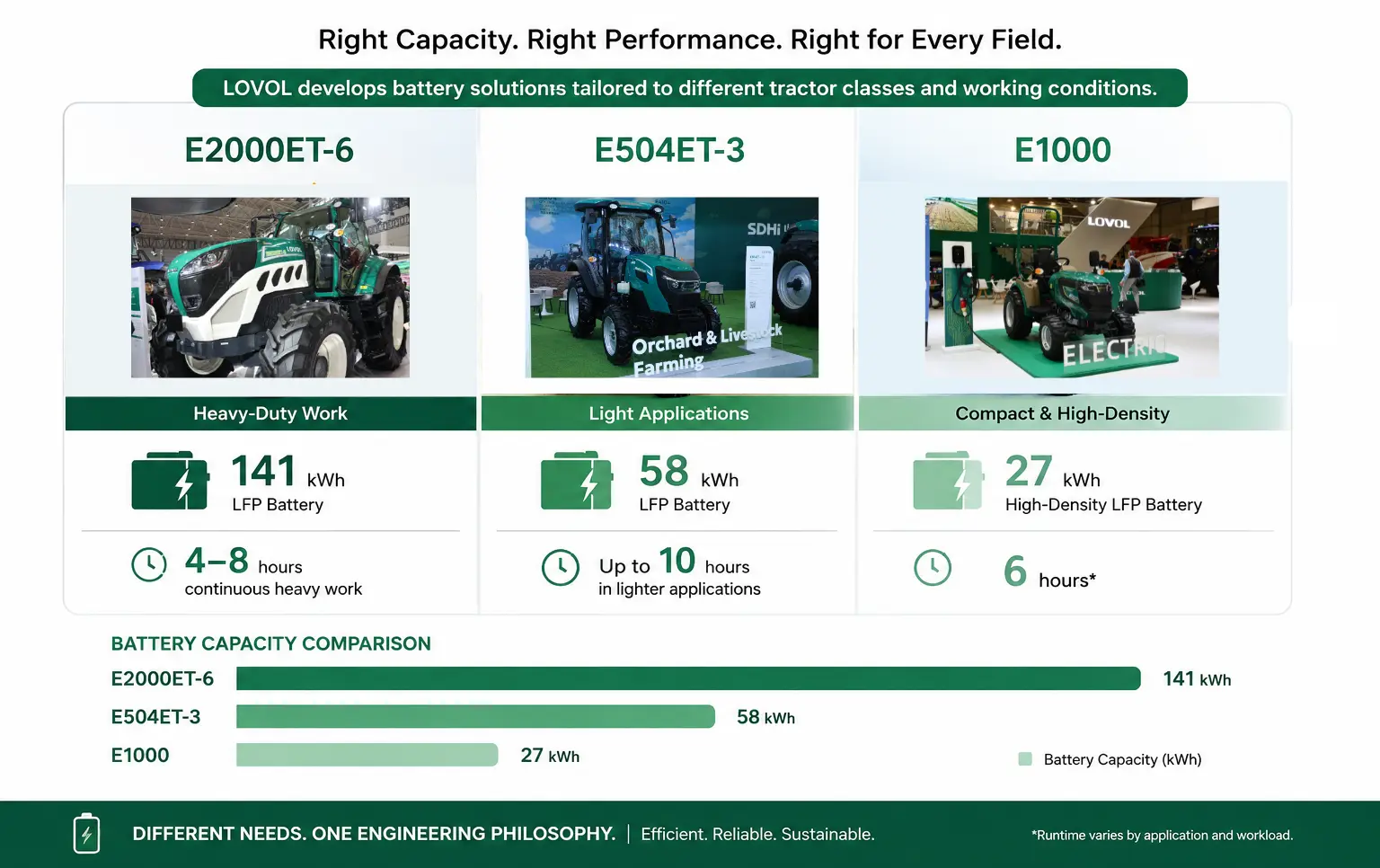
💡 Key Insight: This is not just about capacity—it’s about engineering batteries that can survive the heat, dust, and vibration of real farm conditions.
For a deeper dive into battery types and charging solutions, see our detailed breakdown.
Powertrain Architectures: ECVT vs. AMT + Dual-Motor Direct Drive
LOVOL pursues two distinct powertrain strategies depending on the application:
- For Heavy Tillage (E3404-8H Hybrid) – Uses an ECVT (Electronic Continuously Variable Transmission) architecture that enables 0–40 km/h infinitely variable speed control, delivers over 10% higher transmission efficiency than conventional hybrid routes, and cuts fuel consumption by approximately 20%. Academic research confirms that well-designed ECVT configurations can reduce equivalent fuel consumption by 5.17% under plowing conditions while enabling decoupled PTO and travel speed control.
- For Pure Electric Models (E2000ET-6 & E504ET-3) – Adopts an AMT + dual-motor direct drive architecture. This setup allows PTO output from 0 to 1000 r/min with infinitely variable precision, eliminating mechanical losses associated with traditional transmissions and delivering instant torque response that diesel engines cannot match.
❓ Not sure which powertrain fits your farm? Compare hybrid and pure electric options side by side.
Charging Solutions: Fast Charging vs. Opportunity Charging
The E2000ET-6 and E504ET-3 both support 1-hour fast charging—a significant improvement over the 8–12 hour charge times that once made electric tractors impractical for peak seasons. Today's fast-charging capability, combined with intelligent thermal management systems that protect battery health during high-current charging, means operators can recharge during a meal break and return to the field.
For farms without access to high-power charging infrastructure, opportunity charging—plugging in during idle periods between tasks—remains a practical alternative. The key is matching the charging strategy to the farm's specific workflow and tractor charging infrastructure availability.
Battery performance is closely tied to the tractor's regenerative braking and energy management system. Explore how regenerative braking extends battery life.
Smart Control: ISOBUS and Electro-Hydraulic Systems
The ISOBUS (ISO 11783) standard creates a universal communication interface between tractors and implements, regardless of manufacturer. This means plug-and-play implement recognition, automatic parameter configuration, and remote diagnostics—all controlled from a single terminal in the cab, reducing operator workload and improving precision.
LOVOL’s E3404-8H features a fully wire-controlled heavy-duty chassis with electro-hydraulic control for every function, integrating a sophisticated hydraulic system that delivers precise implement control. The integrated smart cabin consolidates all controls into an intuitive interface, allowing the operator to manage complex field operations with minimal effort.
Learn more about how ISOBUS enables smarter implement control.
Electric vs. Diesel
Electric vs. Diesel Tractors (2026): Cost, Performance & Usability Compared
The decision between electric and diesel tractors is not about which is"better" in absolute terms—it’s about which is better for your specific operation. Here’s how they compare across the factors that matter most.
1.Operating Costs: Where Electric Gains an Edge
The upfront purchase price of an electric or hybrid tractor remains higher than a comparable diesel model. However, the total cost of ownership tells a different story.
Cost Factor | Diesel Tractor | LOVOL Electric/Hybrid | Savings |
Fuel/Energy | High (diesel + DEF) | Low (electricity) | ~70% per hour |
Maintenance | Oil, filters, belts, transmission fluid | Battery cooling, electrical checks | Up to 80% reduction |
Downtime | Frequent service intervals | Minimal moving parts | More field time |
📊 Real-World Example:
The E3404-8H hybrid delivers approximately 20% fuel savings compared to conventional diesel tractors in heavy tillage applications. For pure electric models like the E2000ET-6, the cost per hour drops even further—electricity is significantly cheaper than diesel per unit of energy, and electric drivetrains have far fewer moving parts.
💡 Maintenance Checklist:
- ❌ No engine oil changes
- ❌ No fuel filters or DEF (Diesel Exhaust Fluid)
- ❌ No complex transmission servicing
- ✅ Check battery cooling system
- ✅ Inspect electrical connections
- ✅ Rotate tires
Over a typical 10-year ownership period, maintenance savings alone can offset a substantial portion of the higher purchase price. Maintenance is where electric tractors really shine—see what's different in our maintenance comparison guide.
Calculate your exact ROI with our online tool → – See how much you can save.
2.Performance: Torque Delivery and Response
Diesel engines develop peak torque only within a narrow RPM band—typically between 1400 and 1800 RPM. Below that, they lug. Above that, they lose efficiency. Electric motors, by contrast, deliver peak torque from zero RPM. This means:
- Instant response when you press the pedal
- Precise control at low speeds for delicate operations (vineyard spraying)
- Consistent pull power regardless of engine speed
LOVOL Advantage: For heavy tillage, this translates to better draft force control and less wheel slip. For transport, it means smoother starts even with heavy loads. See how the E3404-8H performs in the field.
3.Convenience: Range, Refueling, and Daily Usability
This is where diesel still holds a clear advantage in some scenarios. Diesel tractors can run all day on a single tank and refuel in five minutes anywhere. Electric tractors require planning:
LOVOL Model | Runtime | Fast Charge Time |
E2000ET-6 | 4–8 hours (heavy work) | 1 hour |
E504ET-3 | Up to 10 hours (light work) | 1 hour |
The practical answer depends on your operation:
- For livestock farms with predictable daily routes → Electric is seamless
- For orchards with intermittent tasks → Electric excels
- For custom operators covering thousands of acres → Hybrid or diesel may still be more practical
4.Environmental Impact: Emissions and Noise
Aspect | Diesel | LOVOL Electric |
Tailpipe Emissions | PM, NOx, CO₂ | Zero |
Cab Noise | 80–90 dB | As low as 75 dB (E504ET-3) |
🍇 Quiet Enough for Vineyards: At just 75 dB inside the cab, the E504ET-3 is quiet enough for indoor use in livestock barns, for nighttime operations without disturbing neighbors, and for vineyards where noise can affect pollination.
Scenario Summary: Which Electric Tractor Fits Your Farm?
Scenario | Recommended Powertrain | LOVOL Model |
Heavy tillage, continuous long days, remote fields | Hybrid | E3404-8H |
Livestock farms, indoor operations | Pure electric | E2000ET-6 |
Orchards, vineyards, greenhouses | Pure electric | E504ET-3 |
European small-to-medium mixed farms | Pure electric | E1000 |
Custom contracting, varied locations, no fixed base | Diesel or hybrid | - |
For heavy tillage applications, the hybrid powertrain offers a compelling solution.
Smart Farming Integration
How Electric Tractors Power the Future of Smart Farming
The electric tractor is more than a powertrain upgrade—it is the ideal platform for the next generation of smart farming. Electric drivetrains offer precise, instantaneous control over speed, torque, and implement functions, making them the perfect foundation for autonomous operation, AI-driven decision-making, and IoT-enabled fleet management.
Autonomous Driving: From L2 to L4
LOVOL’s electric tractor lineup already features L2-level autonomous driving capabilities, including auto-steer, assisted control, and centimeter-level GPS navigation . This means the tractor can maintain precise straight-line travel and execute basic maneuvers with minimal operator intervention. Farmers can focus on overseeing operations rather than wrestling with the steering wheel.
The Next Frontier – L3 & Beyond:
According to industry reports, L3 systems integrate multi-sensor fusion—combining radar, cameras, and lidar—to achieve response times under 0.5 seconds. These systems enable autonomous headland turns, implement lift and lower, and coordinated multi-machine operations. Unmanned convoy operations have demonstrated up to 40% efficiency gains in field trials .
Ready to go deeper into autonomous features? Explore our guide to GPS auto-steer and self-driving tractors.
Precision Agriculture Platform & AI Integration
At the core of LOVOL’s smart farming ecosystem is China’s first industry-grade AI large model purpose-built for agriculture . Trained on tens of millions of agricultural data points—including equipment operation logs, crop monitoring data, and satellite remote sensing—this AI platform operates on a cloud-edge collaborative architecture that delivers real-time intelligence to the field.
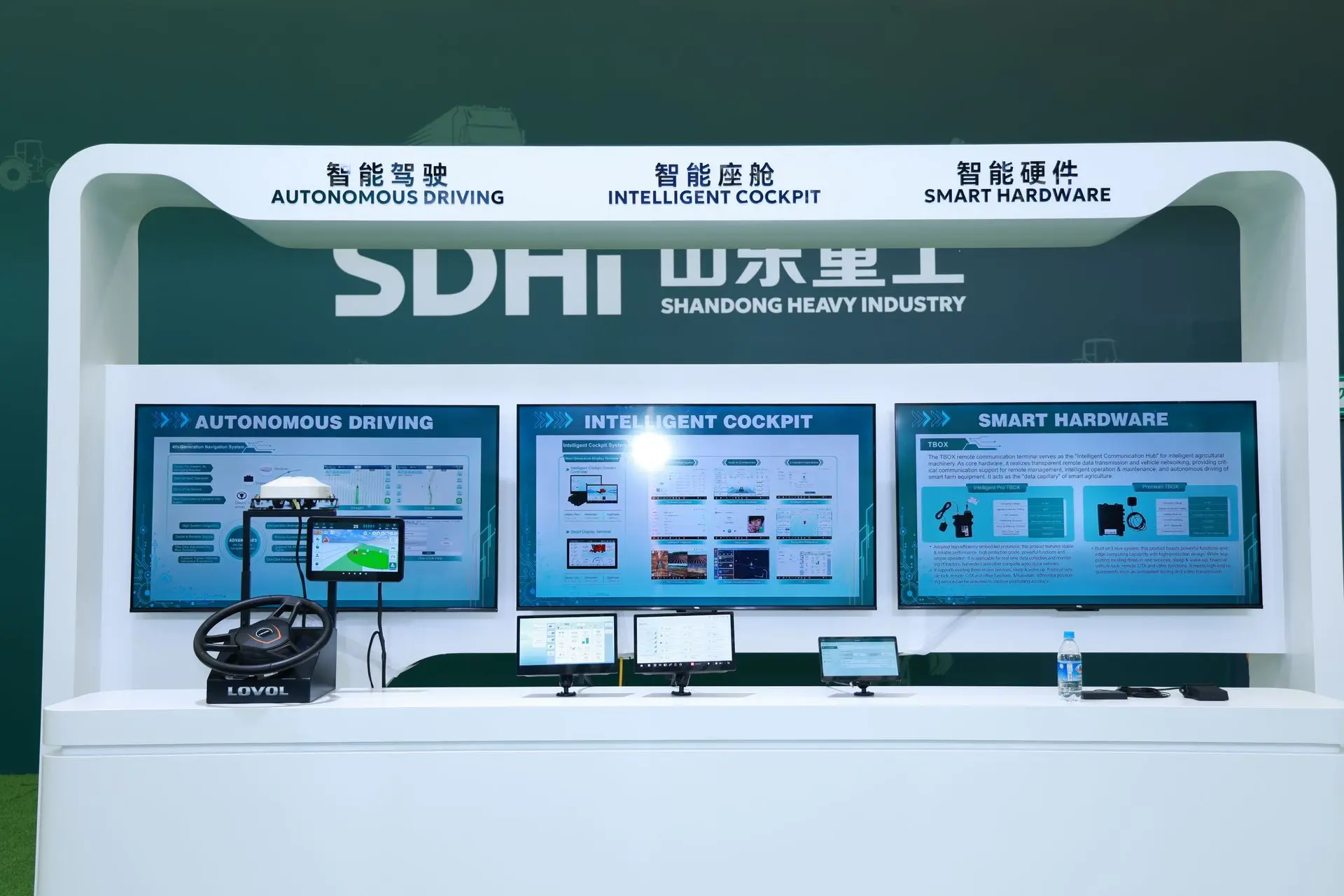
The AI model enables a full-chain decision-making loop:
- Pre-planting: Analyzes field history to recommend optimal crop varieties and seeding densities.
- In-season: Fuses satellite, drone, and IoT sensor data to detect pest risks and nutrient needs.
- Harvest: Predicts optimal harvest timing and coordinates autonomous harvesters.
📈 Field Data Confirms the Impact: 10% yield increase, 5% seed savings, 10% reduction in fertilizer/pesticide use, and 50% water savings.
Learn how electric tractors integrate with precision agriculture platforms.
IoT Connectivity & Fleet Management
The LOVOL Smart Agriculture Management Platform brings IoT-enabled fleet management to the farm office. Every machine’s location, operation path, working status, and progress are displayed on a digital dashboard in real time .
Current Scale: LOVOL has built over 70 smart farms across different agricultural regions in China, with the platform serving more than 10 million mu (≈1.6 million acres) of farmland.
Why Electric Is the Ultimate Smart Farming Platform
The marriage of electric tractors and smart farming is not coincidental. Electric drivetrains offer three advantages that diesel cannot match:
- Precision control: Instant torque response for centimeter-level accuracy.
- Data integration: Rich operational data feeds AI models for optimization.
- Low maintenance: Less downtime keeps autonomous systems operating when the harvest window opens.
While diesel tractors can be retrofitted with guidance and telematics, they lack the foundational electronic architecture that makes full autonomy and deep AI integration possible. Electric tractors are not just cleaner—they are smarter by design.
Ready to go deeper into autonomous features? Explore our guide to GPS auto-steer and self-driving tractors.
Applications & Key Models
LOVOL Electric Tractor Lineup (2025-2026): Models for Every Farming Application
The electric tractor is more than a powertrain upgrade—it is the ideal platform for the next generation of smart farming. Electric drivetrains offer precise, instantaneous control over speed, torque, and implement functions, making them the perfect foundation for autonomous operation, AI-driven decision-making, and IoT-enabled fleet management.
Built for Your Farm — The LOVOL Electric Lineup
We don’t just build tractors—we build tailored solutions for the way you actually work. Whether it’s the E504ET-3 for narrow vineyards, the E2000ET-6 for low-noise livestock barns, or the E3404-8H for heavy tillage, every model in our electric lineup is engineered with real-world farm conditions in mind. Below is our complete portfolio—find the one that fits your operation.
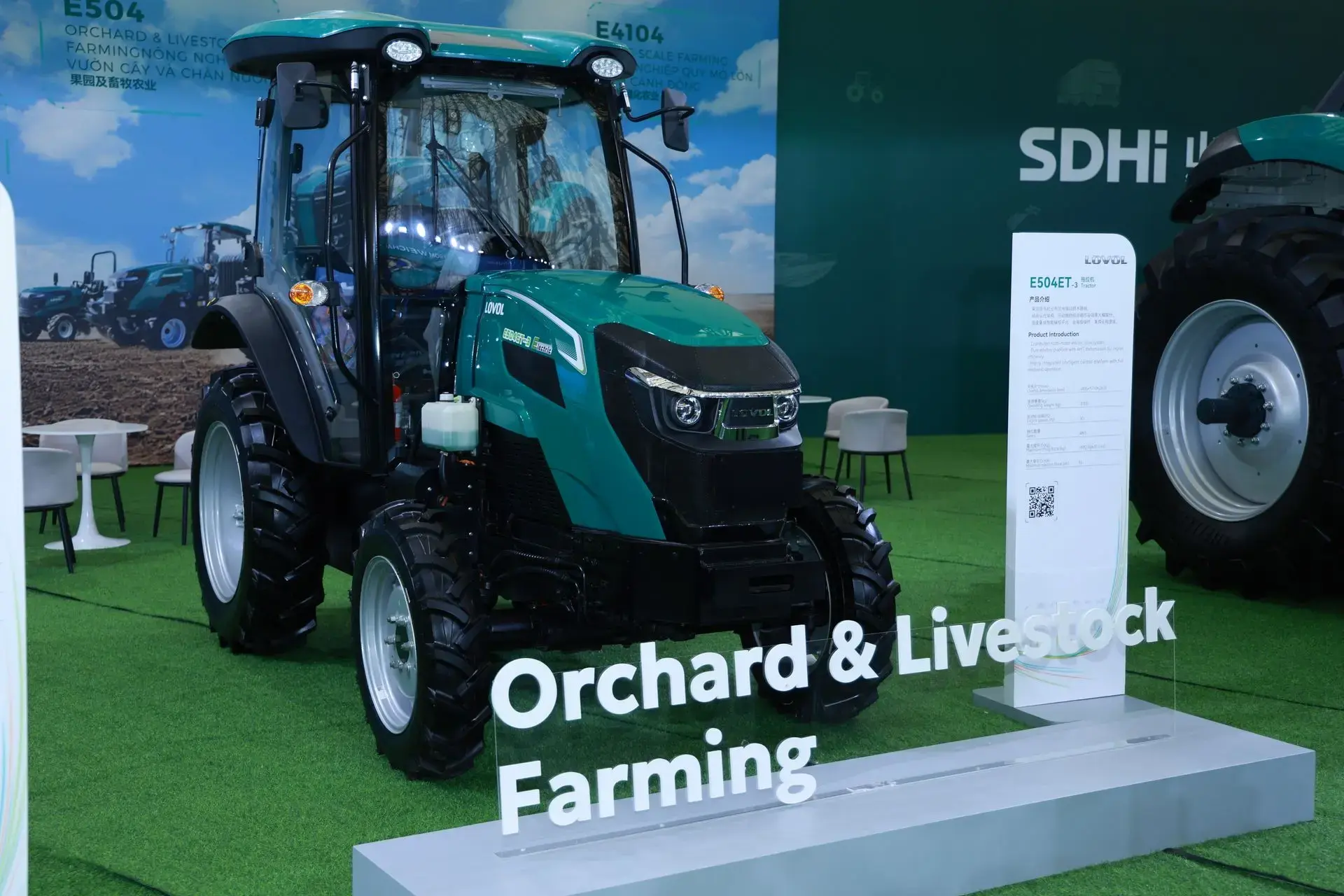
LOVOL has built a comprehensive electric and hybrid tractor portfolio covering every major farming scenario. Whether you need a large farm electric tractor for heavy tillage, a dedicated electric tractor for livestock farms , or a compact electric tractor for vineyards—there is a LOVOL model designed for your specific needs.
Model | Powertrain | Key Specs | Best For | Core Advantage |
E3404-8H | Hybrid ECVT | 0-40km/h IVT, 10%+ efficiency gain, 20% fuel savings, fully wire-controlled chassis | Large farms: heavy tillage, subsoiling, combined tillage | "The optimal electrification solution for heavy tillage" |
E2000ET-6 | Pure Electric AMT + Dual-Motor Direct Drive | 141kWh LFP battery, 4-8h operation, 1h fast charge, L2 autonomous driving, PTO 0-1000r/min | Livestock farms: TMR mixing, indoor operations | "Zero emission, low noise—purpose-built for ranches" |
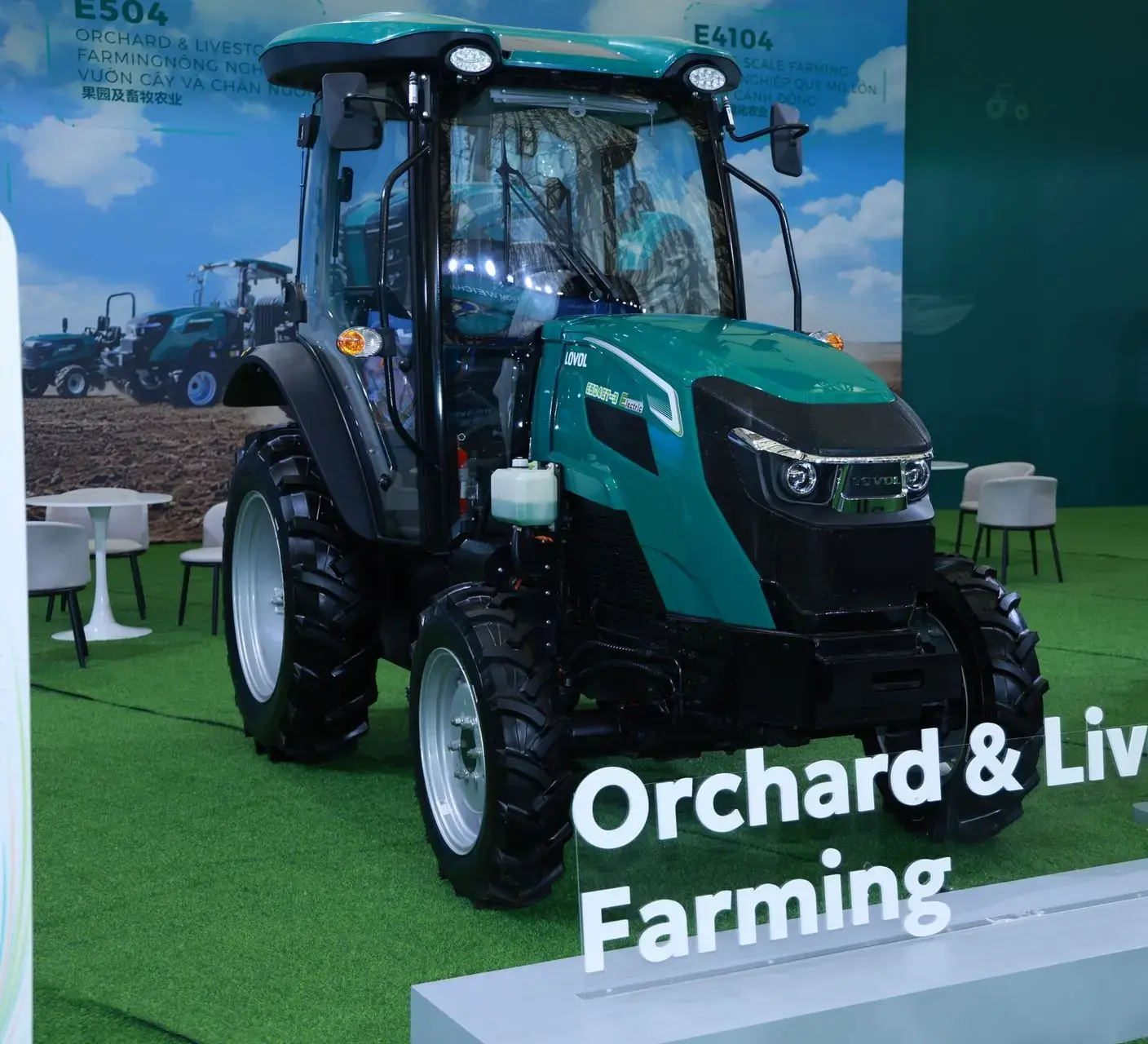
E504ET-3 | Pure Electric Dual-Motor Direct Drive | 58kWh LFP battery, up to 10h runtime, 1h fast charge, 75dB cabin, L2 autonomy | Orchards, vineyards, greenhouses | "Compact zero-emission, the orchard first choice" |
E1000 | Pure Electric | 27kWh LFP battery, 6h heavy-duty operation, IP67 rating, -20°C operation | European small-to-medium farms | Agritechnica-launched, EU-certified |
For specific recommendations on vineyard and orchard applications, check out our dedicated guide. For livestock farm operations and TMR mixing, see how E2000ET-6 performs in the field.
Buying Guide
How to Choose the Right Electric or Hybrid Tractor for Your Farm
Choosing an electric or hybrid tractor is not just about picking the most powerful model. It’s about matching the right technology to your specific operation. Use this four-step decision framework to identify your best option.
The electric tractor is more than a powertrain upgrade—it is the ideal platform for the next generation of smart farming. Electric drivetrains offer precise, instantaneous control over speed, torque, and implement functions, making them the perfect foundation for autonomous operation, AI-driven decision-making, and IoT-enabled fleet management.
Step 1: Define Your Primary Operation Type
Different applications demand different powertrain solutions. How to choose an electric tractor starts with understanding your primary operation:
- Heavy tillage, subsoiling, and combined tillage → The E3404-8H hybrid is purpose-built for these high-draft tasks, delivering 20% fuel savings with ECVT efficiency gains.
- Livestock operations, TMR mixing, and indoor work → The E2000ET-6 pure electric provides zero emissions and exceptionally low noise—critical for enclosed barn environments.
- Orchards, vineyards, and greenhouses → The E504ET-3 pure electric combines narrow-body maneuverability with a 10-hour runtime and 75dB cabin quietness.
- Small-to-medium mixed farms in Europe → The E1000 pure electric is sized for diverse operations in regions with stringent emission regulations.
Still unsure between hybrid and pure electric? Our side-by-side comparison breaks it down in detail.
Step 2: Match to Farm Scale
Farm size determines both the power requirement and the payback timeline:
Farm Scale | Annual Cropland | Recommended Model |
Large-scale | 8,000 mu (≈ 1,300 acres) | E3404-8H |
Livestock operations | Varies by herd size | E2000ET-6 |
Small-to-medium | < 8,000 mu | E504ET-3 or E1000 |
Step 3: Assess Charging Conditions
Your charging infrastructure—or lack thereof—directly impacts usability:
- ✅ 3-phase power available? Essential for 1-hour fast charging
- ✅ Charging station installable? Consider electrical service upgrades
- ✅ Charging windows during workday? For continuous all-day operations, fast charging is non-negotiable
Step 4: Budget and ROI Calculation
The total cost of ownership equation has three components:
- Purchase price: Premium offset by lower operating costs
- Operating cost savings: Fuel + maintenance savings
- Available subsidies: Check EPA and local programs for clean farm equipment incentives
To see the exact numbers for your operation, use our ROI calculator. Understanding electric tractor price dynamics across the ownership lifecycle is essential for making a sound financial decision.
Key Specs to Compare
Specification | Why It Matters |
Engine/PTO power | Determines implement compatibility and work capacity |
Battery capacity (kWh) | Directly impacts runtime between charges |
Fast charge capability | Reduces downtime during peak seasons |
IP rating | Indicates dust/water protection for rugged field conditions |
Cold-weather operation | Essential for northern climate farms |
This buying guide framework will help you navigate the key parameters and make an informed decision.
Future Trends
The Next Frontier: What’s Ahead for Electric Farm Equipment
The electric tractor market is evolving faster than most industry observers predicted. According to MarketsandMarkets, the global electric tractor market is projected to grow from USD 0.7 billion in 2024 to USD 3.4 billion by 2030, at a CAGR of 28.3% . The next five years will bring even more dramatic changes.
Solid-State Batteries: The Next Leap in Energy Storage
Today's lithium iron phosphate (LFP) batteries have transformed electric tractors from experimental novelties into practical farm tools. But the next generation of battery technology—solid-state batteries—promises to accelerate this shift even further. Industry analysts identify solid-state battery technology as a key driver that will propel the electric tractor market over the next 4-5 years, advancing the solid-state battery tractor segment significantly.
Solid-state batteries replace the liquid electrolyte in conventional lithium-ion cells with a solid material. This yields three critical advantages for farm equipment:
- Higher energy density: More power in the same physical space, extending runtime without increasing battery weight
- Faster charging: Reduced downtime during peak seasons
- Improved safety: Eliminating the fire risk associated with liquid electrolytes
According to industry experts, lithium-ion battery prices could drop by 30-45% by 2026, driven by advances in battery chemistry and manufacturing scale. As solid-state technology matures toward commercial viability, the cost gap between electric and diesel tractors will continue to narrow—accelerating adoption across all farm sizes.
Hydrogen and Methanol: Expanding the Clean Fuel Portfolio
While battery-electric tractors excel in many applications, hydrogen fuel cells offer a complementary solution for extended range. Major manufacturers are actively developing hydrogen tractors. In Japan, Kubota unveiled a fully autonomous hydrogen fuel-cell tractor prototype in 2025.
In China, the National Agricultural Machinery Innovation Center developed the ET504-H hydrogen-electric tractor, achieving over 55% power generation efficiency and operating at just 55 dB—quieter than normal conversation . Meanwhile, the world‘s first methanol-hydrogen hybrid smart tractor made its debut in late 2025, powered by a 340 HP methanol-hydrogen direct-drive powertrain that delivers 46% lower energy costs compared to diesel.
AI-Driven Fully Autonomous Operations
Artificial intelligence is fundamentally reshaping what farm equipment can do. Industry experts note that AI is driving the transformation of agricultural machinery from"iron oxen that replace human labor" to"intelligent partners capable of autonomous decision-making". The 2026 Central No. 1 Document explicitly calls for promoting the integration of AI with agriculture.
LOVOL’s AI large model, which integrates satellite remote sensing, soil sensor data, and equipment operation logs, is already delivering measurable results. The model has shortened R&D cycles by over 20% and is now supporting field operations across more than 7 million mu of farmland . As AI technology continues to evolve, the progression from L3 to L4 autonomy will enable complete unmanned workflows—from tillage to planting to harvest.
The Bigger Picture: A Platform for the Future
The trends outlined above are not isolated developments. They converge on a single direction: the electric tractor is becoming an intelligent, connected platform that integrates energy, data, and automation. The academic literature confirms this trajectory, noting that the technological evolution is shifting from a single energy transition to a systematic restructuring of vehicle architecture, where electric drive platforms, intelligent control algorithms, and digital twin technologies converge to create "smart operation terminals" with global optimization and autonomous decision-making capabilities.
For a deeper dive into each of these trends—plus more—check out our full breakdown of the Top 5 Emerging Technologies in Electric Farm Machinery.
Summary: Key Takeaways
Section | Core Message |
Introduction | 2026 marks the turning point where electric/hybrid tractors go mainstream. |
Technology Deep Dive | LFP batteries, ECVT/AMT+dual-motor, fast charging, and ISOBUS form the core tech stack. |
Electric vs. Diesel | Lower operating costs, instant torque, and zero emissions make electric compelling—use case matters. |
Smart Farming | Electric platforms are the ideal foundation for autonomy, AI, and IoT. |
Product Lineup | Four LOVOL models cover every major farming application. |
Buying Guide | Follow the four-step framework: operation → scale → charging → budget/ROI. |
Future Trends | Solid-state batteries, hydrogen fuel cells, and AI-driven autonomy define the next 5–10 years. |
Ready to make the switch?
Contact LOVOL today → for a personalized consultation, or request a demo to experience our electric tractors in action.